A drain cleanout is a capped access pipe fitted to a home’s main sewer line or another drain line. It gives a plumber a direct opening for clearing blockages and inspecting the pipe. Because the opening already exists, a technician can feed in a cable, a jetting hose or a camera without removing a toilet, cutting into pipe or working through a roof vent. Cleanouts serve the main line, which carries all of a home’s wastewater, and sometimes branch lines that serve a single group of fixtures, so the fitting is broader than one pipe. It should not be confused with a trap, floor drain, vent or manhole, none of which are designed as a capped service opening on the line.
Most cleanouts are 3 to 6 inches in diameter and sit either outdoors near the foundation or indoors in a basement or utility room, closed by a removable threaded cap. Their main uses are clearing grease, debris and roots with snakes or hydro jetting, and inspecting pipe condition with a camera, which also shows whether a clog is local or in the main line. They also act as a relief point. When the main line is obstructed, wastewater pressure can escape at the cleanout cap instead of backing up into the lowest drains, such as showers or floor drains. That visible overflow works as an early warning, giving homeowners time to stop using water and call for help before sewage reaches the living space.
How Does a Drain Cleanout Work?
A drain cleanout works by providing an opening in the line that is sealed with a threaded cap and plug, so equipment can enter the pipe directly instead of through a fixture. The assembly is typically a pipe rising from the main line, often on a tee or wye fitting, with a threaded plug that forms a watertight seal and is opened with a wrench. Many installations are two-way, with openings angled toward both the house and the street, which lets a plumber work in either direction from one location. When the cap is on, the line behaves like a normal closed pipe; when it comes off, the technician has a straight path to the blockage.
Technicians use three main tools through the opening: a drain cable or auger, a hydro jetter and an inspection camera, and a drain technician usually performs the work. Snaking and jetting work best when entering the line right at the access point, because the equipment travels a short, straight run rather than bending through traps and fixture connections. A camera shows what the obstruction is, whether grease, roots or debris, and whether the pipe itself is damaged, so the right method can be chosen. Going in directly also reduces the mess and labor of pulling toilets or climbing roof vents to reach a deep blockage.
Safety matters because a blocked line can be under pressure. Removing the cap yourself when a blockage is suspected can release pressurized wastewater and sewer gas. Plumbers manage that risk with specialized gear and containment plans, loosening the cap gradually and controlling any discharge. Cleanouts are usually found outside near the foundation, in basements or near property lines, though landscaping can bury or hide them over time. A visible, accessible cap is what makes the quick, controlled service described above possible when a clog appears.
Sewer Cleanout vs. Drain Cleanout: Is There a Difference?
In everyday use there is little difference: sewer cleanout, drain cleanout and main sewer line cleanout are several names for the same access fitting. The distinction is mostly scope. Sewer cleanout usually names the access to the main line, while drain cleanout can describe an opening on any drain line, including branches and stack bases. Usage varies by region and by plumber, so the label alone rarely tells you which line a fitting serves. The table below compares how the terms are typically used.
| Term | Usual meaning |
|---|---|
| Sewer cleanout | Main line access |
| Drain cleanout | Any drain line access |
| Branch cleanout | One fixture group |
When a plumber says only cleanout, they usually mean the main line access, the one that serves the entire sewer line out to the street. Branch cleanouts are different because each serves one fixture group, such as a bathroom group or a laundry area, and they appear in larger or more complex plumbing systems. Almost every home should have at least one main cleanout for its primary sewer line, even if secondary cleanouts are absent. The practical meaning is that a branch cleanout can clear only its own section, while the main cleanout reaches the whole run.
Floor drain lines and stack bases can also carry cleanouts, which is why drain cleanout is the broader phrase. If you are describing a problem to a plumber, say where the fitting is and what it serves rather than relying on one term. That avoids confusion when one contractor says sewer cleanout and another says drain cleanout for the same fitting. It also helps when getting quotes, since the line being cleared determines the work involved.
What Are the Types of Drain Cleanouts?
Drain cleanouts are classified by location, by the line they serve and by cap style, so one fitting can fall into all three groups at once. By line, a main cleanout sits at the junction of the building drain and the sewer, a stack base cleanout is at the bottom of a vertical stack, and lateral or intermediate cleanouts appear along other runs. Roof stack cleanouts, often test tees, sit at the top of drainage stacks and are used mainly for pressure testing rather than routine maintenance. The main cleanout is the standard access for the primary sewer line, with branch cleanouts added in larger systems.
By location, cleanouts are indoor, in basements, utility rooms or garages, or outdoor, near the foundation, in the yard or at the property line. Outdoor units often sit at grade level, flush with or slightly above the ground, so the cap stays protected from dirt and traffic. Indoor units are typically exposed on a wall or floor before the line meets the foundation. Each location has trade-offs, covered further in the sections that follow.
- By line: main, stack base, branch
- By location: indoor, outdoor
- By cap: threaded, expansion, flush
Cap style varies too. The most common is a threaded plug screwed into the fitting, made of PVC, ABS or brass. Expansion plugs seal by tightening a bolt and suit damaged threads, while flush plugs sit level in high-traffic areas. Two-way cleanouts allow access toward both the building and the street, whereas single cleanouts give one direction only. Older homes may also have a house trap, a U-shaped fitting on the main line near the front foundation wall, which is only a limited access point.
What Does a Cleanout Look Like?
A cleanout looks like a short capped pipe, often with a threaded cap and a square nut on top that a wrench can turn, sitting at ground level or flush with a floor. It may be covered by a box or lid, which can make it easy to overlook in a lawn or garage. Indoors, the fitting is a T- or Y-shaped pipe with a threaded cap, usually 3 to 6 inches in diameter. The cap is the visible clue, since it is the only part meant to come off.
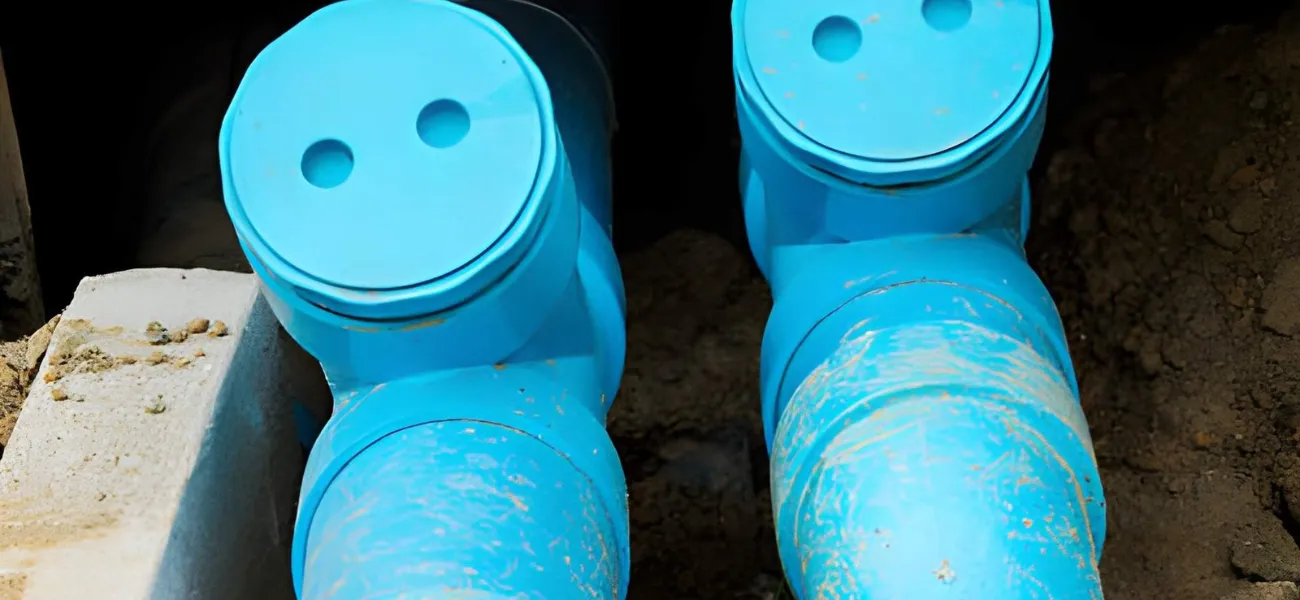
Outdoors, the cleanout is typically white PVC or black ABS pipe rising a few inches above the ground near the foundation. Its cap may be plastic, or a square nut turned with a heavy-duty wrench, and it is usually the same diameter as the pipe beneath. Because it sticks up only slightly, mowing, mulch and plantings can hide it. Looking along the wall where the main drain would exit is the best place to start.
Older cleanouts look different. Cast iron fittings with corroded plugs are common in older homes, and the plug may be rusted so that it looks like part of the pipe. Metal caps in this condition can seize, so they are often hard to recognize and harder to open. Their age also means they may be cracked or discolored where they meet the soil or floor. A wrench-ready nut or threaded ring is the clue that it is a service opening.
Cleanouts are sometimes confused with vents or irrigation parts, which also poke up from the ground. A vent is typically open or has a screen or cap that is not meant to be unscrewed, while irrigation parts connect to small tubing and valves rather than a wide drain pipe. The wide diameter, threaded cap and position near the foundation are the strongest cues. If you are unsure, a plumber can confirm what a fitting is before anyone tries to open it.
Exterior vs. Interior Cleanouts
Exterior cleanouts sit outside the house, near the foundation or between the home and the street, while interior cleanouts are inside, in basements, crawl spaces, garages or utility rooms. Which one a home has depends largely on its layout and climate, and some homes have both. Exterior cleanouts also give an overloaded line an overflow point outside the house instead of at a basement drain. That can keep sewage out of the living space during a main line blockage.
Exterior units are easy to reach without entering the home, and any mess stays outdoors during service. Their drawbacks come from exposure: freezing weather can affect them in cold regions, and landscaping, soil or paving can bury the cap over time. A cover or box helps, but it still needs to be kept clear. Where the cap is not visible, plumbers may lose time finding it before they can begin.
Interior cleanouts are common in basements, crawl spaces and slab homes in colder regions because they are protected from freezing. They are also used in homes without yard access, or in climates where outdoor cleanouts are impractical. Typical spots include near the stack base or in a utility room, along the main drain. They are less likely to be buried by landscaping, and they are sheltered from weather and foot traffic.
The trade-off indoors is mess containment. Opening a backed-up line inside can send wastewater onto the floor of living or storage areas. Access can be tighter, particularly in crawl spaces, and a cleanout may be hidden behind stored items. Outdoors, spills are easier to wash away, but the cap needs protection from burial and freezing. Neither is better in every case, so the right choice is the one that fits the home’s layout and climate.
Why Are Drain Cleanouts Important?
Drain cleanouts matter because they let you clear clogs, restore flow, inspect the line and reduce the risk of sewage backups without cutting into the plumbing. Without one, plumbers must pull a toilet or excavate sections of the yard to reach the line, which is slower, messier and more costly. A working cleanout lowers service costs and reduces the risk of property damage for homeowners. Clearing is also cleaner and more hygienic when the work happens at a sealed access point.
Cleanouts also make inspection practical. A camera sent through the opening can detect root intrusion and small cracks before they turn into emergencies. That early information gives homeowners more repair options and may avoid larger excavation work later. A camera survey at the cleanout is also a straightforward way to check the line condition when evaluating a property. Catching a problem early is usually cheaper than dealing with a full backup.
The relief function adds another layer of protection. When the main line blocks, pressure can show up at the cleanout cap first, rather than in the lowest drains indoors. That warning gives you time to stop using water and call a plumber. This is why an accessible cap is more valuable than a hidden one. A cleanout that is easy to find and open turns a major repair into a routine service call.
Where Is the Drain Cleanout Located and How Do You Find It?
The cleanout is usually near where the main drain leaves the house: in a basement or utility room near the main drain, or outside near the foundation or in the yard if there is no basement. Municipal homes may have two main cleanouts, while homes on septic typically have one main cleanout leading to the septic tank.
Search in this order:
- check the exterior near the foundation and in the yard;
- look at the basement, garage or bathroom floor;
- find the stack base;
- follow the main drain toward the foundation exit. Starting at the largest vertical drain pipe in the basement and following it to the exit is a reliable method.
In a slab or crawl-space home, look along the exterior wall where plumbing exits and in the yard line toward the street. Check whether the home is connected to a municipal sewer or a septic system, since the layout differs. Missouri homes, for example, typically have the cleanout in the basement near the main drain or utility room, or outside near the foundation if there is no basement. If you cannot locate it, a plumber can trace the line and find or recommend adding one.
How Many Cleanouts Should a Home Have and What Do Codes Require?
Almost every home should have at least one main cleanout, but how many a home has depends on its age, layout and local jurisdiction, so older houses may have none. Cleanouts are placed at the base of stacks, at the main exit, at direction changes, along long horizontal runs and at junctions. More cleanouts are added in larger or complex plumbing systems. The logic is that every run should be reachable by equipment without too many bends.
Spacing rules limit how far apart cleanouts can be on horizontal drain piping: 75 feet maximum for pipe 4 inches or smaller, and 100 feet maximum for pipe 5 inches and larger. At a vertical stack base, the cleanout must be at least 6 inches above the lowest flood level rim of the fixtures it serves. These figures describe typical plumbing code requirements. The adopted edition and local amendments govern.
Size, clearance and access requirements also matter, since a cleanout must be reachable and have room for tools. Codes vary by jurisdiction and change with each adopted edition, so confirm requirements with the local building department or a licensed plumber. A home built before modern codes may not meet current spacing or placement rules. Adding or moving a cleanout usually needs a plumber who knows the local requirements.
What Are Common Drain Cleanout Problems?
Common cleanout problems fall into access, structural and sealing issues: caps are buried, painted over, blocked or missing, and fittings can be cracked, corroded or leaking. Older metal caps may corrode and seize, while newer caps may be buried by landscaping or paving, which makes them useless in an emergency. Stripped threads prevent a proper cap seal, causing leaks and difficulty opening the fitting. Missing or damaged caps let debris, stormwater and sewer gas move in or out.
- Buried or hidden cap
- Seized or corroded cap
- Stripped threads or worn gasket
- Cracked pipe or riser
Cracks or breaks, especially in older cast iron, can allow groundwater infiltration and weaken the surrounding line. Worn gaskets or ground shifting can also cause leaks that bring health hazards and attract pests. Debris, leaves or dirt can collect around ground-level units and block the access point. Root intrusion usually affects pipe joints downstream rather than entering through the sealed cap.
How Can You Tell If the Cleanout Is Clogged or the Line Is Backed Up?
The clearest sign of a main line blockage is several drains clogging at once, often with gurgling, or water backing up in toilets and drains.
To confirm,
- stop using water;
- wear gloves and goggles;
- loosen the cap slowly, releasing pressure gradually;
- look inside the pipe without removing the cap fully if water rises.
A healthy cleanout is a dry pipe, with wastewater far below the cap. Standing water or sewage in an opened cleanout indicates a blockage downstream, between the cleanout and the street.
Opening a backed-up cleanout can release gallons of raw wastewater under pressure, so stop if significant pressure is felt or water rises while loosening the cap. If the cleanout is dry but fixtures are slow, the problem is likely in a branch line or a single fixture rather than the main line. A plumber can then use a camera to find the cause. Do not attempt to clear a full backup yourself.
Can You Use a Cleanout Yourself or Should You Call a Plumber?
Homeowners can safely locate the cleanout, keep it clear and check it visually, but opening a suspected backed-up line is a job for a plumber. Clearing vegetation and debris around the cap, noting its location and checking for cracks are all low-risk tasks. If you do open a cap, wear sturdy gloves and goggles. Stop immediately if you feel significant pressure or see water rising as you loosen it.
A backed-up line can push gallons of raw wastewater out under pressure when the cap is removed, creating a health hazard and a cleanup problem. Forcing a seized plug can also strip the threads or damage the line. Call a plumber for repeated backups, suspected tree roots, camera inspection or hydro jetting. These jobs need specialized equipment and give a more lasting fix than a quick attempt at the cap.
What If Your Home Has No Cleanout?
If your home has no cleanout, plumbers must reach the sewer line another way: by removing a toilet or going through the roof vent, both of which take more labor and carry more mess and risk. Homes built before the 1940s codes often lack cleanouts, which makes main line clogs costlier to address. A house trap, a U-shaped fitting on the main line near the front foundation wall, can sometimes serve as a limited access point. A removable fixture trap can count as a cleanout equivalent under code if the drain pipe is no more than one size larger than the removed trap.
The long-term fix is to retrofit an exterior or interior cleanout on the main line. Cost depends on the home and location, so get a local quote from a licensed plumber. While the work is planned, ask about a backwater valve if backups are a concern. A new cleanout means future clogs and inspections can be handled directly instead of by pulling fixtures.
How Do You Maintain a Drain Cleanout and Prevent Clogs?
To maintain a drain cleanout, keep the cap accessible, check its seal and prevent anything from burying it under landscaping or paving. Inspect the cap once or twice a year for cracks or corrosion, and replace it if it is damaged. A properly seated cap screws on snugly without forcing it. If it resists, stop rather than risk stripping the threads.
- Check cap twice a year
- Keep area clear
- No grease or wipes
- Inspect line every few years
Prevent clogs by keeping grease, wipes and paper towels out of drains, and watch for tree roots near the sewer line. A professional sewer line inspection every few years is sensible, and more often for older homes or those with mature trees nearby. How often the main line needs cleaning depends on its age, nearby trees and past problems. Confirm the schedule with a plumber who knows your line.
Frequently Asked Questions
What does a drainage cleanout actually look like?
Most cleanouts appear as a short section of pipe, often white or dark-colored plastic, capped with a round, removable fitting, sitting slightly above ground level in a yard, basement, or utility area. Older homes may have a metal cap instead of plastic.
Do all homes have a sewer cleanout?
No. Many older homes were built without one, which means a plumber has to access the main line through a toilet, sink, or roof vent instead. If you’ve had recurring clogs and can’t locate a cleanout, it’s worth asking a plumber whether adding one makes sense for your home.
What’s the difference between a two-way cleanout and a test tee?
A two-way cleanout allows equipment to be fed in either direction along the sewer line, making it the most versatile option. A test tee connects at a perpendicular angle and is common inside walls, but its angle makes it somewhat harder to navigate cleaning equipment through compared to a two-way setup.
Can I clear a clog through my own cleanout without a plumber?
A basic snake can sometimes be used through an accessible cleanout by a confident homeowner, but main line clogs often need professional-grade equipment and diagnosis, especially if the cause is tree roots, a collapsed pipe, or significant buildup. Opening a cleanout cap on a fully blocked line also carries a risk of sudden wastewater release.
How much does it cost to fix a broken cleanout cap?
A broken or missing cap is generally one of the least expensive cleanout repairs, since it typically only involves replacing the cap itself rather than any excavation or pipe work. Exact pricing depends on the cap type and your local market, so a plumber can confirm current cost for your specific fitting.
Why would a plumber recommend installing a cleanout if I don’t have one?
Adding a cleanout gives future access to your main sewer line without needing to work through fixtures or dig without a clear entry point. While it’s a larger upfront cost, it often reduces the cost and complexity of future drain cleaning, camera inspections, and clog repairs.
Need help with drains?
Explore the relevant services available from Anaheim Plumbing.