More guides in this subject
Choose a guide to explore a specific question, component or repair.
- Hot Water Heater Smell: Common Causes and What to Do About It
- Rust in a Water Heater: Causes, Safety, and How to Fix It
- Water Heater Temperature Fluctuations: Causes & Fixes
- Water Heater Tripping Breaker? Causes & What to Do
- Water Heater Working but No Hot Water: Causes and How to Fix It
- Why Is My Water Heater Leaking? Causes and How to Fix It
- Why Is My Water Heater Making Noise and How Do I Fix It?
Common water heater problems are the faults that stop a residential tank heater from delivering enough hot water safely, whether it runs on electricity or gas. Most trace back to a short list of causes: lost power or fuel, a worn heating element or burner, a misadjusted thermostat, sediment, and corrosion.
Each symptom, such as no heat, odd noises, leaks or smelly water, points toward a likely cause and a fix. Understanding that chain helps you decide quickly what is safe to tackle yourself and what needs a licensed pro.
Many repairs are manageable at home, including resetting a breaker, adjusting the thermostat, relighting a pilot, testing a valve and flushing the tank. Gas leaks, tank leaks, repeated breaker trips and burner work are different, because the risks involve fire, flooding or electrical shock.
Age matters too: sediment slowly insulates the tank, strains components and accelerates corrosion, so small complaints often foreshadow failure. Spotting that pattern early can save a repair bill or prevent water damage.
What Is the Most Common Water Heater Problem?
The most common water heater problem is a lack of hot water, meaning none at all, only lukewarm water, or a supply that runs out quickly. The causes fall into a few groups: no power or a tripped breaker, a failed heating element or gas burner and pilot, a faulty thermostat, sediment buildup, and a tank too small for the household. Because so many separate faults produce the same complaint, the symptom alone rarely tells you what is wrong. That overlap is why diagnosis should proceed from the simplest and safest checks to the more involved ones.
Electric heaters most often lose hot water from a faulty heating element, while gas heaters usually suffer a pilot, thermocouple or pilot control valve fault. An undersized unit or heavy sediment can instead cause insufficient hot water, and a faulty thermostat or element can contribute as well. Noting when the problem happens helps: hot water gone from the start suggests power or ignition, while a supply that fades quickly suggests sediment or capacity. Working through those clues narrows the list before you touch any part.
How Do You Diagnose a Water Heater Problem?
Diagnose a water heater by moving from safety checks to simple causes: confirm power or fuel, check the thermostat, then look for leaks, noises and temperature patterns. Early signs of decline include inconsistent heating, a sharp rise in utility bills and frequent repairs, so treat those as prompts to investigate.
- Turn off power or gas for the task.
- Check breaker or pilot light.
- Confirm thermostat near 120°F.
- Inspect for leaks and noises.
Before touching anything, turn off the breaker for electric work or shut off the gas before any burner work. If you smell gas, leave the home and call the utility right away.
Water Heater Not Heating or Running Out of Hot Water
Hot water problems come in four forms: none, lukewarm, slow to heat, or a short supply, and each points to different causes. No hot water usually means lost power, a failed element on an electric unit, or a pilot or thermocouple fault on a gas unit. Lukewarm water can come from a thermostat set too low, a failed element, or a cracked dip tube. Slow heating and short supply more often reflect sediment or an undersized tank.
Sediment settles at the tank bottom and blocks heat transfer, so the burner or lower element works harder for less usable hot water. A cracked dip tube sends cold incoming water to the top of the tank, where it mixes with hot water and leaves faucets lukewarm. A faulty thermostat can misread tank temperature, and demand that exceeds tank capacity simply drains the hot supply sooner than expected. Distinguishing these patterns tells you whether to flush, adjust or replace.
Start with the easy items: confirm the thermostat sits around 120°F, check the breaker or pilot, then consider flushing if the unit has not been drained recently. Dip tubes are inexpensive, costing only a few dollars, though replacing one means draining the tank and some plumbing work. If these steps fail, the cause is probably a failed element, control or thermocouple, and professional inspection is wise. The next three subsections cover electric faults, gas faults and fast depletion.
Electric Water Heater: No or Weak Heat
For an electric heater with no or weak heat, check the breaker, press the high-temperature limit reset button, verify thermostat settings, then test the heating elements. Electric units draw 18 to 25 amps on a dedicated circuit, so a shorted element can trip the breaker. Reset a tripped breaker by switching it fully off, then on. If it trips again, stop and call a licensed plumber or electrician.
For the limit switch, turn off power at the service panel, remove the access panel and press the red reset button. Thermostats should be correctly set and replaced if they malfunction, since a bad one can cause weak or inconsistent heat. Never work with the power on, and confirm it is off before removing any panel or touching wiring. Live power is the most serious mistake in electric water heater repair.
The two elements play different roles: the upper element heats the top of the tank first, and the lower element does most of the ongoing heating. To test one, cut power, remove the access panel, and read it with a multimeter; a good element reads about 10 to 16 ohms. An infinite reading means it has burned out. Elements cost $15 to $30 and take about an hour to swap. Replace both together, and flush sediment that insulates the lower element.
Gas Water Heater: Pilot Light and Ignition Problems
On a gas heater, first check whether the pilot light is out, and relight it following the manufacturer’s instructions printed on the unit. The pilot is a small continuous flame near the bottom that ignites the burner when hot water is needed. If cold weather has been severe, frozen lines may be the cause and must be thawed before heating can resume. Never relight if you smell gas.
A pilot that keeps going out usually points to a faulty thermocouple, a pilot control valve fault, a gas supply problem, or a clogged pilot orifice. Models with electronic ignition can fail for electrical reasons, and some gas heaters need electricity for ignition or controls. Poor venting can also disrupt combustion. Because each of these touches the gas path, persistent outages call for professional repair.
Gas safety has a firm boundary: if you smell gas, leave the home and call the utility from outside. Shut off the gas before any burner work, and do not try burner repairs yourself. Simple relighting is reasonable when the manufacturer’s steps are followed carefully and no gas odor is present. Beyond that, leave the burner, thermocouple and valves to a licensed plumber.
Why Does the Hot Water Run Out Too Fast?
Hot water runs out too fast when demand exceeds usable capacity, which happens with an undersized tank, heavy sediment, a broken dip tube or a thermostat set too low. Each cause shrinks the amount of truly hot water available, even though the tank itself is full. Matching the fix to the cause avoids wasted money. Start with the cheapest checks before considering a larger heater.
Tank size matters because a household that adds people or appliances can outgrow the heater. Sediment is a quieter culprit: it occupies space at the bottom of the tank and blocks heat transfer, so less volume heats properly. Flushing removes it and is considered a fairly easy fix. Repeat until the water runs clear.
A cracked dip tube sends incoming cold water to the top of the tank rather than the bottom, so it blends with hot water and leaves faucets lukewarm. Replacement tubes cost only a few dollars. A thermostat set too low also limits supply, and 120°F is the recommended balance of safety and storage capacity. Adjust it gradually and retest after about an hour.
Your fix options run in order of cost: adjust the thermostat, flush the tank, replace the dip tube or faulty element, and only then upsize the heater. If the unit is large enough but still falls short after those steps, a failing thermostat or element is likely. If household demand has truly grown, a larger tank or different heater type may be justified. Professional sizing advice helps in that case.
Water That Is Too Hot or Inconsistent in Temperature
Water that is too hot or swings in temperature usually points to a thermostat set too high, miscalibrated or faulty, and scalding is the main danger. Water heaters ship set to 120°F, which is the typical household setting balancing comfort, scald prevention and energy use. Higher settings raise burn risk and waste energy. A faulty thermostat is also a known cause of inconsistent temperatures.
To adjust safely, change the thermostat in small steps and never above 140°F, then wait about an hour and retest at a tap. If water is still cold, the thermostat or a heating element may be at fault. For electric units, turn off power at the breaker before opening any access panel. Replace a thermostat that does not respond correctly to its setting.
Faults in an element or control can cause uneven heating, and sediment can cause overheating by interfering with heat transfer. The temperature and pressure relief valve matters here: if it discharges because of high temperature or pressure, treat it as a warning. Do not cap or block the valve, since it is a crucial safety device. Persistent overheating or valve discharge calls for professional help.
Leaking Water Heater: Where It Comes From and What to Do
A leaking water heater can leak from inlet and outlet fittings, the drain valve, the T&P relief valve or the tank body, and only the tank body leak means replacement. Shut off power or gas and close the cold-water supply immediately, then place a pan or towels to limit damage. Leaks can cause flooding, water stains, mold growth and higher energy bills. Check the source before deciding whether it is a quick repair.
Fitting leaks are the simplest: water pooling at the top usually comes from the cold inlet, so tighten clockwise with a wrench and replace the fitting if it is stripped. A dripping drain valve may need tightening or replacement, and it is a $10 part. Valves that leak may need tightened or replaced washers, while a T&P relief valve leak can come from high pressure or a faulty valve. A missing or undersized expansion tank can add excess pressure.
A tank leak from corrosion or cracks cannot be safely repaired and requires a new water heater. Age, wear and hard-water mineral buildup weaken the tank, and unflushed sediment can crack its walls and floor. Loose heating element bolts are another possible source on electric units. Use the table below to sort fixable leaks from replacement cases.
| Leak location | Likely cause | Fix |
|---|---|---|
| Inlet/outlet | Loose fitting | Fixable |
| Drain valve | Worn valve | Fixable |
| Tank body | Corrosion | Replace |
How to Test the Pressure Relief Valve
Test the pressure relief valve once a year by placing a bucket under the discharge pipe and briefly lifting the lever. The valve is a crucial safety component that prevents excessive pressure buildup, and a replacement costs about $20. Water should flow and then stop when the lever is released. Wait for the tank to cool before testing to avoid scalding.
A valve that keeps dripping, will not flow or sticks open is defective, and an old, loose or misinstalled valve can fail. Replace a broken valve right away through a professional. If it discharges on its own, the cause may be high pressure or temperature, so look deeper. An undersized or absent thermal expansion tank is a common contributor.
Strange Noises: Rumbling, Popping and Hissing
Rumbling, popping and banging usually mean sediment is on the tank floor, where steam bubbles force their way through the layer and make noise in water heater. Limescale can crackle on elements, and a faulty element can also make strange noises. Keeping the thermostat near 120°F reduces overheating-related noise. Flushing removes the sediment and typically ends the sounds.
| Sound | Cause | Response |
|---|---|---|
| Rumbling/popping | Sediment | Flush |
| Crackling | Limescale | Descale |
Routine sounds are brief ticking or expansion as the tank heats, while ongoing banging or popping deserves action. The table maps each noise to its likely cause and response. Sounds with leaks, hot water loss or relief valve discharge are urgent. Persisting noise after flushing points toward an element or other fault, so call a professional.
Discolored, Rusty or Smelly Hot Water
Rusty, yellow or reddish hot water usually signals corrosion inside the tank, while a rotten egg smell suggests bacteria growing inside it. First test cold water: if only the hot water is affected, the heater is the problem. If cold water is also discolored or smelly, the supply is suspect, and iron or hydrogen sulfide in it could be the cause. A water test is advised when unsure.
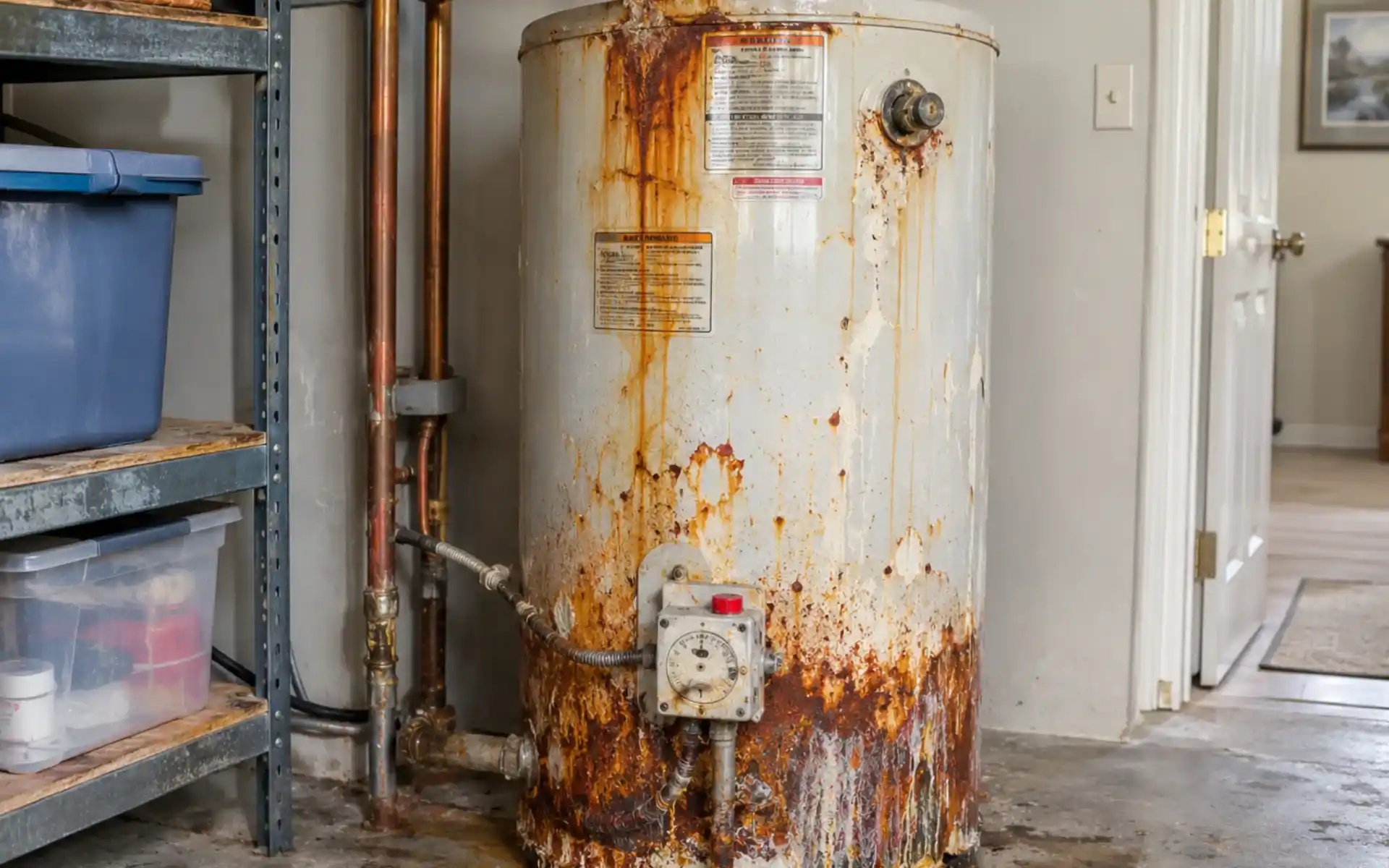
A failing anode rod is a common reason: this sacrificial metal rod attracts corrosive elements so the tank does not corrode. Replace it every three to five years for about $30, and consider zinc or aluminum rods, which are less likely to produce odors. Rusty, brown or cloudy water can also be sediment or rust. Corroded water can be harmful if ingested, so address it promptly.
For bacterial odor, raise the tank to 140°F for a few hours to pasteurize, then flush and return to 120°F. Another remedy is to fill the tank with water and hydrogen peroxide, let it sit about two hours, then flush with clear water. Hard water speeds mineral buildup, so a water softener protects the heater and other appliances. Persistent odor warrants testing.
How to Flush a Water Heater
Flush a water heater at least once a year by shutting off power or gas, closing the cold-water valve, and draining the tank through a garden hose. First set gas thermostats to Pilot or cut power at the fuse box, and let the tank sit at least two hours to avoid burns. Attach the hose to the drain valve and open a hot faucet to relieve pressure. Do not send warm or hot water onto the lawn or plants.
- Turn off power or set gas to Pilot.
- Close the cold-water valve; wait two hours.
- Attach hose and open drain.
- Rinse until clear, refill, restore power.
Rinse with cold water until it runs clear, then close the drain valve and refill with a hot faucet open until flow is steady. Only then restore the thermostat or power. A common mistake is restoring power to an empty tank, which can damage elements. Another is skipping the cooling period.
Limescale and Sediment Buildup
Limescale forms when hard water minerals, mainly calcium and magnesium, settle in the heated tank and harden into scale. The scale lowers heat transfer and lifespan, threatens the heating element and raises energy use. Symptoms include banging or crackling, less hot water or slower heating, and element failure. Sediment layers worsen these effects.
Prevention works best before the tank: a water softener or water heater filter reduces scale, and then the tank should be cleaned of existing deposits. Flush periodically, and keep the temperature moderate. Descaling agents can also be used regularly. Tankless units can be flushed with vinegar circulated through a hose.
Low Water Pressure and Rising Energy Bills
Low hot water pressure with normal cold pressure points to mineral deposits or a malfunctioning pressure regulator, while whole-house loss suggests clogged lines or a partly closed valve. Check that the shutoff valves are fully open, and see whether only hot taps are weak. Mineral buildup narrows pipes and fittings over time. Flushing the heater can help if deposits are the cause.
Rising energy bills often mean the heater is losing efficiency, because sediment insulates the heating element and forces it to use more energy. A misset thermostat or aging components can add to costs. Flushing the tank can improve efficiency, and insulating the first six feet of hot water pipe cuts standby losses. Modern models can save up to $300 annually on energy costs.
Common Causes of Water Heater Failure and Life Expectancy
Water heaters fail mainly from corrosion, sediment, excess pressure and neglected maintenance, and these factors compound each other. Sediment insulates and overheats the tank, hard water scale stresses elements, and a worn anode rod lets corrosion reach the steel. Missing or undersized expansion tanks allow pressure spikes. Annual flushing and anode checks slow the process.
Traditional tank heaters typically last 8 to 12 years with routine care, and neglected units fail sooner. Tankless water heaters often last 15 to 20 years, though some estimates put the range at 10 to 20 years. Water quality and upkeep shift where a unit lands within those ranges. Hard water shortens life.
Signs of end of life include inconsistent heating, a sharp rise in utility bills and frequent repairs. Rusty water, leaks from the tank body and persistent noise add to the case. A tank leak cannot be safely repaired. Plan replacement before failure to avoid water damage.
Repair or Replace: When to Call a Professional
Replace a water heater when it is over 10 years old, failing often or has a damaged tank, and repair when the fault is a simple part. Thermostats, elements, dip tubes, anode rods and relief valves are inexpensive fixes, while a tank leak means replacement. Call a licensed plumber for gas leaks, repeated breaker trips, relief valve failures or burner work. Upgrading to a tankless or heat pump model may cut energy costs.
| Situation | Action |
|---|---|
| Tripped breaker, pilot out | DIY |
| Gas leak, burner work | Pro |
| Tank leak, 10+ years | Replace |
The table shows how situations usually split between DIY, professional help and replacement. Compare the repair cost with a new unit, and weigh the age and recurring faults. Never attempt gas or water leak repairs yourself. A newer heater can also reduce energy bills.
Maintenance That Prevents Most Water Heater Problems
Most water heater problems are prevented with a short routine: flush yearly, inspect the anode rod, test the relief valve, check the thermostat and look for leaks. The annual check takes about fifteen minutes. Keep the thermostat at 120°F to protect against scalding and scale. Insulate the first six feet of hot water pipe.
Schedule tasks by water quality: hard water calls for more frequent flushing and a softener or filter. Replace the anode rod every three to five years. Electric units need checks of breaker and element performance, and gas units need pilot and venting checks. Test the relief valve yearly with a bucket under the discharge pipe.
Use the checklist as a yearly reference and keep notes on dates so patterns are easy to spot. Call a plumber when the checks reveal problems you cannot safely fix. Regular care extends the life of a tank heater toward the upper end of its 8 to 12 year range. Small habits prevent expensive failures.
Frequently Asked Questions
Here are the questions homeowners most often ask about common water heater problems, along with direct answers.
How do I know if a water heater problem is an emergency?
Active leaking, a complete loss of hot water in a home with vulnerable residents, a strong gas smell, or water that’s scalding hot straight from the tap are all situations worth same-day attention. Noise, minor temperature inconsistency, or slightly reduced hot water capacity are generally safe to schedule within a few days to a couple of weeks.
Can sediment buildup really cause this many different problems?
Yes. Sediment is one of the most common root causes across several symptoms on this list, including noise, reduced hot water capacity, and temperature inconsistency, since it insulates the heating element or burner and reduces the tank’s effective volume. Annual flushing is the main way to prevent it from accumulating to this point.
Is it normal for a water heater to make some noise?
A brief, quiet hum or occasional tick as metal expands and contracts is generally normal. Persistent popping, rumbling, or banging is not, and usually signals sediment buildup that’s affecting the unit’s efficiency and, over time, its lifespan.
Should I try to fix a water heater problem myself?
Checking a breaker, attempting to relight a pilot following the manufacturer’s instructions, or visually inspecting for loose fittings are generally within a homeowner’s comfort zone. Anything involving the tank’s wiring compartment, gas line, or an active leak from the tank itself is safer left to a licensed professional.
Why does my hot water smell different from my cold water?
If only the hot water has an odor, the water heater itself, rather than your home’s water supply, is almost always the source. Bacteria growth or a corroding anode rod inside the tank are the most common causes, and both are typically resolved with maintenance or a part replacement rather than requiring a full tank replacement.
At what point should I stop troubleshooting and call a professional?
If a symptom persists after a single reasonable troubleshooting attempt, such as resetting a breaker once or relighting a pilot once, or if you notice active leaking, a gas smell, or scalding water, it’s time to call a licensed plumber rather than continuing to test or reset components yourself.
Need help with water heaters?
Explore the relevant services available from Anaheim Plumbing.